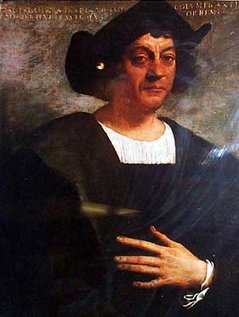
Christopher Columbus (1451– 20 May 1506) (Cristóbal
Colón in Spanish, Cristoforo Colombo in Italian) was an explorer
and trader who crossed the Atlantic Ocean and reached the Americas
on October 12, 1492 under the flag of Castile. History places a great
significance on his landing in America in 1492, with the entire period
of the history of the Americas before this date usually known as Pre-Columbian,
and the anniversary of this event, Columbus Day, celebrated in many
countries in the Americas. Besides the fact that there were many instances
of Pre-Columbian trans-oceanic contact, and it is questionable whether
one person can "discover" a place which is inhabited by other
people, Columbus is often credited as having discovered America. His
voyage marked the beginning of the Spanish and European colonization
of the Americas. He was most likely Genoese, although some historians
claim he could have been born in other places, from the Crown of Aragón
to the Kingdoms of Galicia or Portugal, or in the Greek island of Chios
among others.
Background
Columbus believed that the Earth was a relatively small sphere, and
argued that a ship could reach India via a westward course. The widespread
notion that Columbus encountered opposition based on the idea that
the Earth was flat is a literary myth created by Washington Irving.
Educated people in Columbus's time agreed that the earth was round;
anyone familiar with seafaring certainly knew it, since the roundness
of the Earth forms the basis of celestial navigation. The main debate
was over whether a ship could circumnavigate the planet without running
out of food or getting stuck in windless regions.
Columbus was not the first European to reach the continent. Many historians today acknowledge the fact that Leifur Eiríksson had traveled to North America from Iceland in the 11th century and set up a short-lived colony at L'Anse aux Meadows. There are also many theories of expeditions to the Americas by a variety of peoples throughout time; see Pre-Columbian trans-oceanic contact, one of the most consistent is the exploration (before 1472) of two, led by João Vaz Corte-Real to Terra Verde (today's Newfoundland). Giovanni Caboto (better known as John Cabot) was first to reach the American mainland (which Columbus did not reach until his third voyage). However, there is one thing that sets off Columbus' first voyage from all of these: less than two decades later, the existence of America was known to the general public throughout Europe. This is likely due to the invention of the printing press. Additionally, although Columbus is credited in Western classical education as the "discoverer of America" , the two continents are named after Amerigo Vespucci, who reached what is now the coast of Brazil in 1501 and whose name was first applied to the map by cartographer Martin Waldseemüller.
Columbus landed in the Bahamas and later explored much of the Caribbean, including the isles of Juana (Cuba) and Espanola (Hispaniola), as well as the coasts of Central and South America. He never reached the present-day United States where "Columbus Day" (The second monday of October, with 12 October being the anniversary of Columbus' landing in the Bahamas) is celebrated as a holiday.
Unlike the voyage of the Icelanders, Columbus' voyages led to a relatively quick, general and lasting recognition of the existence of the New World by the Old World, the Columbian Exchange of species (both those harmful to humans, such as viruses, bacteria, and parasites, and beneficial to humans, such as tomatoes, potatoes, maize, and horses), and the first large-scale colonization of the Americas by Europeans.
Columbus remains a controversial figure. Some – including many Native Americans – view him as responsible, directly or indirectly, for the deaths of tens, if not hundreds, of millions of indigenous peoples, exploitation of the Americas by Europe, and slavery in the West Indies. Others honour him for the massive boost his explorations gave to Western expansion and culture. Italian Americans hail Columbus as an icon of their heritage.
It has generally been accepted that he was Genovese, although doubts have persistently been voiced regarding this. His name in Italian is Cristoforo Colombo, in Spanish is Cristóbal Colón, in Catalan it is Cristòfor Colom and in Portuguese Cristóvão Colombo. Columbus is a Latinized form of his surname. The Latin roots of his name can be translated "Christ-bearer, Dove". Columbus' signature reads Xpo ferens ("Bearing Christ").
Columbus claimed governorship of the new territories (by prior agreement with the Spanish monarchs) and made several more journeys across the Atlantic. While regarded by some as an excellent navigator, he was seen by many contemporaries as a poor administrator and was stripped of his governorship in 1500.
Early Life
There are various versions of Columbus's origins and life before 1476.
(See Columbus's National Origin.) The account that has traditionally
been supported by most historians is as follows:
Columbus was born between August 26 and October 31 in the year 1451, in the Italian port city of Genoa. His father was Domenico Colombo, a woollens merchant, and his mother was Susanna Fontanarossa, the daughter of a woollens merchant. Christopher had three younger brothers, Bartolomeo, Giovanni Pellegrino, and Giacomo, and a sister, Bianchinetta.
In 1470, the family moved to Savona, where Christopher worked for his father in wool processing. During this period he studied cartography with his brother Bartolomeo. Christopher received almost no formal education; a voracious reader, he was largely self-taught.In 1474, Columbus joined a ship of the Spinola Financiers, who were Genoese patrons of his father. He spent a year on a ship bound towards Khios (an island in the Aegean Sea) and, after a brief visit home, spent a year in Khios. It is believed that this is where he recruited some of his sailors.
A 1476, commercial expedition gave Columbus his first opportunity to sail into the Atlantic Ocean. The fleet came under attack by French privateers off the Cape of St. Vincent, Portugal. Columbus's ship was burned and he swam six miles to shore.
By 1477, Columbus was living in Lisbon. Portugal had become a center for maritime activity with ships sailing for England, Ireland, Iceland, Madeira, the Azores, and Africa. Columbus's brother Bartolomeo worked as a mapmaker in Lisbon. At times, the brothers worked together as draftsmen and book collectors.
He became a merchant sailor with the Portuguese fleet, and sailed to Iceland via Ireland in 1477. He sailed to Madeira in 1478 to purchase sugar, and along the coasts of West Africa between 1482 and 1485, reaching the Portuguese trade post of Elmina Castle in the Gulf of Guinea coast.
Columbus married Felipa Perestrello Moniz, a daughter from a noble Portuguese family with some Italian ancestry, in 1479. Felipa's father, Bartolomeu Perestrelo, had partaken in finding the Madeira Islands and owned one of them (Porto Santo Island), but died when Felipa was a baby, leaving his second wife a wealthy widow. As part of his dowry, the mariner received all of Perestello's charts of the winds and currents of the Portuguese possessions of the Atlantic. Columbus and Felipa had a son, Diego Colón in 1480. Felipa died in January of 1485. Columbus later found a lifelong partner in Spain, an orphan named Beatriz Enriquez. She was living with a cousin in the weaving industry of Córdoba. They never married, but Columbus left Beatriz a rich woman and directed Diego to treat her as his own mother. The two had a son, Ferdinand in 1488. Both boys served as pages to Prince Juan, son of Ferdinand and Isabella of Castile, and each later contributed, with fabulous success, to the rehabilitation of their father's reputation.
The Idea
Christian Europe, long allowed safe passage to India and China (sources
of valued trade goods such as silk and spices) under the hegemony of
the Mongol Empire (Pax Mongolica, or "Mongol peace"), was
now, after the fragmentation of that empire, under a complete economic
blockade by Muslim states. In response to Muslim hegemony on land,
Portugal sought an eastward sea route to the Indies, and promoted the
establishment of trading posts and later colonies along the coast of
Africa. Columbus had another idea. By the 1480s, he had developed a
plan to travel to the Indies (then roughly meaning all of south and
east Asia) by sailing west across the Ocean Sea (the Atlantic Ocean)
instead.
It is sometimes claimed that the reason Columbus had a hard time receiving support for this plan was that Europeans believed that the Earth was flat. This myth can be traced to Washington Irving's novel The Life and Voyages of Christopher Columbus (1828).
The fact that the Earth is round was evident to most people of Columbus's time, especially other sailors, explorers and navigators (Eratosthenes (276-194 BC) had in fact accurately calculated the circumference of the Earth). The problem was that the experts did not agree with his estimates of the distance to the Indies. Most scholars accepted Ptolemy's claim that the terrestrial landmass (for Europeans of the time, Eurasia and Africa) occupied 180 degrees of the terrestrial sphere, leaving 180 degrees of water.
Columbus accepted the calculations of Pierre d'Ailly, that the land-mass occupied 225 degrees, leaving only 135 degrees of water. Moreover, Columbus believed that one degree actually covered less space on the earth's surface than commonly believed. Finally, Columbus read maps as if the distances were calculated in Roman miles (1524 meters or 5,000 feet) rather than nautical miles (1853.99 meters or 6,082.66 feet at the equator). The true circumference of the earth is about 40,000 km (24,900 statute miles of 5,280 feet each), whereas the circumference of Columbus's earth was the equivalent of at most 30,600 km (19,000 modern statute miles). Columbus calculated that the distance from the Canary Islands to Japan was 2,400 nautical miles (about 4,444 km).
In fact, the distance is about 10,600 nautical miles (19,600 km), and most European sailors and navigators concluded that the Indies were too far away to make his plan worth considering. They were right and Columbus was wrong; had he not unexpectedly encountered a previously uncharted continent in mid-travel, he and his crew would have perished from lack of food and water.
Columbus lobbies for funding
Columbus first presented his plan to the court of Portugal in 1485.
The king's experts believed that the route would be longer than Columbus
thought (the actual distance is even longer than the Portuguese believed),
and denied Columbus's request. It is probable that he made the same
outrageous demands for himself in Portugal that he later made in Spain,
where he went next. He tried to get backing from the monarchs of Aragon
and Castile, Ferdinand of Aragon and Isabella of Castile, who, by marrying,
had united the largest kingdoms of Spain and were ruling them together.
After seven years of lobbying at the Spanish court, where he was kept on a salary to prevent him from taking his ideas elsewhere, he was finally successful in 1492. Ferdinand and Isabella had just conquered Granada, the last Muslim stronghold on the Iberian peninsula, and they received Columbus in Córdoba (in the monarchs' Alcázar or castle). Isabella finally turned Columbus down on the advice of her "think tank" and he was leaving town in despair when Ferdinand lost his patience. Isabella sent a royal guard to fetch him and Ferdinand later rightfully claimed credit for being "the principal cause why those islands were discovered."
About half of the financing was to come from private Italian investors, which Columbus had already lined up. Financially broke from the Granada campaign, the monarchs left it to the royal treasurer to shift funds among various royal accounts on behalf of the enterprise. Columbus was to be made Admiral of the Ocean Sea and granted an inheritable governorship to the new territories he would reach, as well as a portion of all profits. The terms were absurd, but his own son later wrote that the monarchs really didn't expect him to return.
Voyages
The First Voyage
The year 1492, on the evening of August 3, Columbus left from Palos
with three ships, the Santa Maria, Niña and Pinta. The ships
were property of Juan de la Cosa and the Pinzón brothers (Martin
and Vicente Yáñez), but the monarchs forced the Palos
inhabitants to contribute to the expedition. He first sailed to the
Canary Islands, fortunately owned by Castile, where he reprovisioned
and made repairs, and on September 6 started the five week voyage
across the ocean.
A legend is that the crew grew so homesick and fearful that they threatened to hurl Columbus overboard and sail back to Spain. Although the actual situation is unclear, most likely the sailors' resentments merely amounted to complaints or suggestions.
After 29 days out of sight of land, on 7 October 1492 as recorded in the ship's log, the crew spotted shore birds flying west and changed direction to make their landfall. A comparison of dates and migratory patterns leads to the conclusion that the birds were Eskimo curlews and American golden plover.
Land was sighted at 2 AM on October 12 by a sailor aboard Pinta named Rodrigo de Triana. Columbus called the island he reached San Salvador, although the natives called it Guanahani. The Native Americans he encountered, the Taíno or Arawak, were peaceful and friendly. He wrote with such awe of the friendly innocence and beauty of these Indians that he inadvertently created the enduring myth of the Noble Savage. "These people have no religious beliefs, nor are they idolaters. They are very gentle and do not know what evil is; nor do they kill others, nor steal; and they are without weapons.". No blood was shed on this first voyage; he believed conversion to Christianity would be achieved through love, not force.On this first voyage, Columbus also explored the northeast coast of Cuba (landed on October 28) and the northern coast of Hispaniola, by December 5. He believed the peaks of Cuba were the Himalayas of India, which gives one a sense of just how lost he was and how long it took the peoples of the world to map the Earth. (The vast interior of the North and South American mainlands would of course be largely mapped with the leadership of native guides and interpreters.) Here the Santa Maria ran aground and had to be abandoned. He was received by the native cacique Guacanagari, who gave him permission to leave some of his men behind. Columbus founded the settlement La Navidad and left 39 men.
On January 4, 1493 he set sail for home, not yet understanding the elliptical nature of the trade winds that had brought him west. He wrestled his ship against the wind and ran into one of the worst storms of the century. He had no choice but to land his ship in Portugal, where he was told a fleet of 100 caravels had been lost. (Astoundingly, both the Niña and the Pinta were spared.) Some have speculated that landing in Portugal was intentional.
The relations between Portugal and Castile were poor at the time, and he was held up, but finally released. Word of his finding new lands rapidly spread throughout Europe. He didn't reach Spain until March 15, when the story of his journey was in its third printing. He was received as a hero in Spain, and this was his moment in the sun. He displayed several kidnapped natives and what gold he'd found to the court, as well as the previously unknown tobacco plant, the pineapple fruit, the turkey and the sailor's first love, the hammock. Naturally, he did not bring any of the coveted Indian spices, such as the exceedingly expensive black pepper, ginger or cloves. In his log he wrote "there is also plenty of ají, which is their pepper, which is more valuable than [black] pepper, and all the people eat nothing else, it being very wholesome" (Turner, 2004, P11). The word ají is still used in South American Spanish for chili peppers.
Second voyage
Columbus left from Cádiz, Spain for his second voyage (1493-1496)
on September 24, 1493, with 17 ships carrying supplies and about 1200
men to assist in the subjugation of the Taíno and the colonization
of the region. On October 13 the ships left the Canary Islands, following
a more southerly course than on the first voyage.
On November 3, 1493, Columbus sighted a rugged island which he named Dominica. On the same day he landed at Marie-Galante (which he named Santa Maria la Galante). After sailing past Les Saintes (Todos los Santos), Columbus arrived at Guadaloupe (Santa Maria de Guadalupe), which he explored from November 4 through November 10. The exact course of his voyage through the Lesser Antilles is debated, but it seems likely that Columbus turned north, sighting and naming several islands including Montserrat (Santa Maria de Monstserrate), Antigua (Santa Maria la Antigua), Redonda (Santa Maria la Redonda), Nevis (Santa María de las Nieve or San Martin), Saint Kitts (San Jorge), Sint Eustatius (Santa Anastasia), Saba (San Cristobal), and Saint Martin or Saint Croix (Santa Cruz). Columbus also sighted the island chain of the Virgin Islands, (which he named Santa Ursula y las Once Mil Virgines), and named the islands of Virgin Gorda, Tortola, and Peter Island (San Pedro).
Columbus continued to the Greater Antilles and landed at Puerto Rico (San Juan Bautista) on November 19, 1493 . On November 22, he returned to Hispaniola, where he found his colonists had fallen into dispute with Indians in the interior and had been killed. He established a new settlement at Isabella, on the north coast of Hispaniola where gold had first been found but it was a poor location and the settlement was short-lived. He spent some time exploring the interior of the island for gold and did find some, establishing a small fort in the interior. He left Hispaniola on April 24, 1494 and arrived at Cuba (which he named Juana) on April 30 and Jamaica on May 5. He explored the south coast of Cuba, which he believed to be a peninsula rather than an island, and several nearby islands including the Isle of Youth (La Evangelista) before returning to Hispaniola on August 20.
Before he left on his second voyage he had been directed by Ferdinand and Isabella to maintain friendly, even loving relations with the natives. However, during his second voyage he sent a letter to the monarchs proposing to enslave some of the native peoples, specifically the Caribs, on the grounds of their aggressiveness. Although his petition was refused by the Crown, in February, 1495 Columbus took 1600 Arawak as slaves. 550 slaves were shipped back to Spain; two hundred died en route, probably of disease, and of the remainder half were ill when they arrived. After legal proceedings, the survivors were released and ordered to be shipped back home. Some of the 1600 were kept as slaves for Columbus's men, and Columbus recorded using slaves for sex in his journal. The remaining 400, who Columbus had no use for, were let go and fled into the hills, making, according to Columbus, prospects for their future capture dim. Rounding up the slaves resulted in the first major battle between the Spanish and the Indians in the new world.
The main objective of Columbus's journey had been gold. To further this goal, he imposed a system on the natives in Cicao on Haiti, whereby all those above fourteen years of age had to find a certain quota of gold, which would be signified by a token placed around their necks. Those who failed to reach their quota would have their hands chopped off. Despite such extreme measures, Columbus did not manage to obtain much gold. One of the primary reasons for this was the fact that natives became infected with various diseases carried by the Europeans.
In his letters to the Spanish king and queen, Columbus would repeatedly
suggest slavery as a way to profit from the new colonies, but these
suggestions were all rejected: the monarchs preferred to view the natives
as future members of Christendom.
Third voyage and arrest
On May 30, 1498, Columbus left with six ships from Sanlúcar,
Spain for his third trip to the New World. He was accompanied by the
young Bartolome de Las Casas, who would later provide partial transcripts
of Columbus's logs.
After stopping in the Canary Islands and Cape Verde, Columbus landed on the south coast of the island of Trinidad on July 31. From August 4 through August 12, he explored the Gulf of Paria which separates Trinidad from Venezuela. He explored the mainland of South America, including the Orinoco River. He also sailed to the islands of Chacachcare and Margarita Island and sighted and named Tobago (Bella Forma) and Grenada (Concepcion). Initially, he described the new lands as belonging to a previously unknown new continent, but later he retreated to his position that they belonged to Asia.
Columbus returned to Hispaniola on August 19 to find that many of the Spanish settlers of the new colony were discontent, having been misled by Columbus about the supposedly bountiful riches of the new world. Columbus repeatedly had to deal with rebellious settlers and Indians. He had some of his crew hanged for disobeying him. A number of returned settlers and friars lobbied against Columbus at the Spanish court, accusing him of mismanagement. The king and queen sent the royal administrator Francisco de Bobadilla in 1500, who upon arrival (August 23) detained Columbus and his brothers and had them shipped home. Columbus refused to have his shackles removed on the trip to Spain, during which he wrote a long and pleading letter to the Spanish monarchs.
Although he regained his freedom, he did not regain his prestige and lost his governorship. As an added insult, the Portuguese had won the race to the Indies: Vasco da Gama returned in September 1499 from a trip to India, having sailed east around Africa.
Last (fourth) voyage
Nevertheless, Columbus made a fourth voyage, nominally in search of
the Strait of Malacca to the Indian Ocean. Accompanied by his brother
Bartolomeo and his thirteen-year old son Fernando, Columbus left Cádiz,
Spain on May 11, 1502. On June 15, they landed at Carbet on the island
of Martinique (Martinica). A hurricane was brewing, so Columbus continued
on, hoping to find shelter on Hispaniola. Columbus arrived at Santo
Domingo on June 29, but was denied port. Instead, the ships anchored
at the mouth of the Jaina River.
After a brief stop at Jamaica, Columbus sailed to Central America, arriving at Guanaja (Isla de Pinos) in the Bay Islands off the coast of Honduras on July 30. Here Bartholomew found native merchants and a large canoe, which was described as "long as a galley" and was filled with cargo. On August 14, Columbus landed on the American mainland at Puerto Castilla, near Trujillo, Honduras. Columbus spent two months exploring the coasts of Honduras, Nicaragua, and Costa Rica, before arriving in Almirante Bay, Panama on October 16.
In Panama, Columbus learned from the natives of gold and a strait to another ocean. After much exploration, he established a garrison at the mouth of Rio Belen in January 1503. On April 6, one of the ships became stranded in the river. At the same time, the garrison was attacked, and the other ships were damaged. Columbus left for Hispaniola on April 16, but sustained more damage in a storm off the coast of Cuba. Unable to travel any farther, the ships were beached in St. Anne's Bay, Jamaica, on June 25, 1503.
Columbus and his men were stranded on Jamaica for a year. Two Spaniards, with native paddlers, were sent by canoe to get help from Hispaniola. In the meantime Columbus, in a desperate effort to induce the natives to continue provisioning him and his hungry men, successfully intimidated the natives by correctly predicting a lunar eclipse, using the Ephemeris of the German astronomer Regiomontanus. Grudging help finally arrived on June 29, 1504, and Columbus and his men arrived in Sanlúcar, Spain, on November 7.
Later life
While Columbus had always given the conversion of non-believers as
one reason for his explorations, he grew increasingly religious in
his later years. He claimed to hear divine voices, lobbied for a new
crusade to capture Jerusalem, often wore Franciscan habit, and described
his explorations to the "paradise" as part of God's plan
which would soon result in the Last Judgement and the end of the world.
In his later years Columbus demanded that the Spanish Crown give him 10% of all profits made in the new lands, pursuant to earlier agreements. Because he had been relieved of his duties as governor, the crown felt not bound by these contracts and his demands were rejected. His family later sued for part of the profits from trade with America, but ultimately lost some fifty years later.
On May 20, 1506, Columbus died in Valladolid, fairly wealthy due to the gold his men had accumulated in Hispaniola. He was still convinced that his journeys had been along the East Coast of Asia. Following his death, the body of Columbus underwent excarnation - the flesh was removed so that only his bones remained. Even after his death, his travels continued: first interred in Valladolid and then at the monastery of La Cartja in Seville, by the will of his son Diego, who had been governor of Hispaniola, the remains were transferred to Santo Domingo in 1542. In 1795 the French took over, and the corpse was removed to Havana. After the war of 1898, Cuba became independent and Columbus's remains were moved back to the cathedral of Seville, where they were given a pompous catafalque. However, a lead box bearing an inscription identifying "Don Christopher Columbus' and containing fragments of bone and a bullet was discovered at Santo Domingo in 1877. To lay to rest claims that the wrong relics were moved to Havana and that Columbus is still buried in the cathedral of Santo Domingo, DNA samples were taken in June 2003 (History Today August 2003).
He was canonized by the antipope Gregory XVII, leader of the breakaway Palmarian Catholic Church.
Columbus's national origin: subject of debate
Serious doubts have been expressed regarding Columbus's national origin.
Although in the popular culture he is generally assumed to be Italian
(Genoese), his actual background is clouded in mystery. Very little
is really known about Columbus before the mid-1470s. It has been suggested
that this might have been because he was hiding something—an
event in his origin or history that he deliberately kept a secret.
The issue of Columbus's 'nationality' became an issue after the rise of nationalism; the issue was scarcely raised until the time of the quadricentenary celebrations in 1892 (see Columbian exposition), when Columbus's Genoese origins became a point of pride for some Italian Americans. In New York City, rival statues of Columbus were underwritten by the Hispanic and the Italian communities, and honourable positions had to be found for each, at Columbus Circle and in Central Park.
One hypothesis is that Columbus served under the French corsair Guillaume Casenove Coulon and took his surname, but later tried to hide his piracy. Some Basque historians have claimed that he was Basque. Others had said that he was a converso (Spanish Jew converted to Christianity). In Spain, even converted Jews were forced to leave Spain after much persecution; it was suggested that many conversos were still practicing Judaism in secret and their success created much envy.
Another theory is that he was from the island of Corsica, which at
the time was part of the Genoese republic. Because the often subversive
elements of the island gave its inhabitants a bad reputation, he would
have masked his exact heritage. A few others also claim that Columbus
was actually Catalan (Colom).
Documents found in the Alentejo region of Portugal suggest he may have
been born there. In accordance with this theory, he named the island
of Cuba after the Portuguese town Cuba in Alentejo — the town
where he, according to Portuguese historians, had been born under the
name of Salvador Fernandes Zarco (SFZ), son of Fernando, Duke of Beja,
and Isabel Sciarra — and grandson of Cecília Colonna.
The Portuguese-origin thesis has him using Colom as a pseudonym. This
is based on interpretation of some facts and documents of his life
(as above), but mostly on an analysis of his signature under the Jewish
Kabbalah, where he described his family and origin (by Macarenhas Barreto: "Fernandus
Ensifer Copiae Pacis Juliae illaqueatus Isabella Sciarra Camara Mea
Soboles Cubae.", or "Ferdinand who holds the sword of power
of Beja (Pax Julia in Latin), coupled with Isabel Sciarra Camara, are
my generation from Cuba"). Since he never signed his name conventionally,
the pseudonymus theory is reinforced, his name meaning in Latin "Bearer
of Christ" (Christo ferens) "and of the Holy Spirit" (Columbus,
dove in Latin), a reference to the Order of Christ which succeeded
the Templars in Portugal and initiated the age of exploration.
The corollary of the above is that he was (i) knowingly diverting the Castilian kings from their target – India and (ii) had all the reasons to hide his identity and origin, as Portugal was the biggest rival of Spain (Castille) in its sea ventures. In sum, he was a "secret agent".
It is also speculated that Columbus may have come from the island of Khios (or Chios) in Greece. The main point of this theory is that Columbus never said he was from Genoa but from the Republic of Genoa, and that he kept his journal in Latin and Greek instead of the Italian of Genoa. He also referred to himself as "Columbus de Terra Rubra"(Columbus of the Red Earth), Khios was known for its red soil in the south of the island where the mastic trees that the Genoese traded grow. The island of Khios was under the Genoese rule (1346 - 1566 AD), for the period of his life, and therefore it was part of the Republic of Genoa. There is a village named Pirgi in the island of Khios where to this day many of its inhabitants carry the surname "Colombus."
It has even been suggested that the epitaph on his tomb, translated as "Let me not be confused forever," is a veiled hint left by Columbus that his identity was other than he publicly stated during his life. However, the actual phrase, "Non confundar in aeternam" (in Latin), is perhaps more accurately translated "Let me never be confounded," and is contained in several Psalms.
It is certain that Columbus taught himself to read and write after arriving in Portugal, learned cutting-edge navigational and trading skills from the Portuguese, was commissioned by Castile, received financial backing from Genoese bankers, and was informed, in his own words, by "wise people, ecclesiastics and laymen, Latins and Greeks, Jews and Moors and with many others of other sects." He was, in other words, a man of the Mediterranean.
The language of Columbus
Although Genoese documents have been found about a weaver named Colombo,
it has also been noted that, in the preserved documents, Columbus wrote
almost exclusively in Castilian, and that he used the language, with
Portuguese phonetics, even when writing personal notes to himself,
to his brother, Italian friends, and to the Bank of Genoa.
There is a small handwritten Genoese gloss in an Italian edition of the History of Plinius that he read in his second voyage to America. However, it displays both Castilian and Portuguese influences. Genoese Italian was not a written language in the 15th century, but one would expect a better transliteration into this dialect from a native speaker. However, many people become "tongue-tied" when using what is to them an intimate childhood language. There is also a note in non-Genoese Italian in his own Book of Prophesies exhibiting, according to historian August Kling, "characteristics of northern Italian humanism in its calligraphy, syntax, and spelling." Columbus took great care and pride in writing this form of Italian.
Phillips and Phillips point out that five hundred years ago, the Latinate languages had not distanced themselves to the degree they have today. Bartolomé de las Casas in his Historia de las Indias explained that Columbus did not know Castilian well and that he was not born in Castile. In his letters he refers to himself frequently, if cryptically, as a "foreigner." Ramón Menéndez Pidal studied the language of Columbus in 1942, suggesting that while still in Genoa, Columbus learned notions of Portugalized Spanish from travelers, who used a sort of commercial Latin or lingua franca (latín ginobisco for Spaniards). He suggests that Columbus learned Spanish in Portugal through its use in Portugal as or "adopted language of culture" from 1450. This same Spanish is used by poets like Fernán Silveira and Joan Manuel. The first testimony of his use of Spanish is from the 1480s. Pidal and many others detect a lot of Portuguese in his Spanish, where he mixes, for example, falar and hablar. But Pidal does not accept the hypothesis of a Galician origin for Columbus by noting that where Portuguese and Galician diverged, Columbus always used the Portuguese form. Pidal doubts that Columbus could ever tell Portuguese and Spanish apart, which is why he did not make the effort to learn them properly.
Latin, on the other hand, was the language of scholarship, and here Columbus excelled. He also kept his journal in Latin, and a "secret" journal in Greek.
According to historian Charles Merrill, analysis of his handwriting indicates that it is typical of someone who was a native Catalan, and Columbus's phonetic mistakes in Castilian are "most likely" those of a Catalan. Also, that he married a Portuguese noblewoman is presented as evidence that his origin was of nobility rather than the Italian merchant class, since it was unheard of during his time for nobility to marry outside their class. This same theory suggests he was the illegitimate son of a prominent Catalan sea-faring family, which had served as mercenaries in a sea battle against Castilian forces. Fighting against Ferdinand and being illegitimate were two excellent reasons for keeping his origins obscure. Furthermore, the disinternment of his brother's body shows him to be a different age, by nearly a decade, than the "Bartolome Colombo" of the Genoese family.
Perceptions of Columbus
Christopher Columbus has had a cultural significance beyond his actual
achievements and actions as an individual; he also became a symbol,
a figure of legend. The mythology of Columbus has cast him as an archetype
for both good and for evil.
The casting of Columbus as a figure of "good" or of "evil" often depends on people's perspectives as to whether the arrival of Europeans to the New World and the introduction of Christianity or the Catholic faith is seen as positive or negative.
Columbus as a hero
Traditionally, Columbus is viewed as a man of heroic stature by the
European-descended population of the New World. He has often been hailed
as a man of heroism and bravery, and also of faith: he sailed westward
into mostly unknown waters, and his unique scheme is often viewed as
ingenious. He "set an example for us all by showing what monumental
feats can be accomplished through perseverance and faith" (George
H. W. Bush, June 8, 1989).
Hero worship of Columbus perhaps reached its zenith around 1892, the 400th anniversary of his first arrival in the Americas. Monuments to Columbus (including the Columbian Exposition in Chicago) were erected throughout the United States and Latin America, extolling him as a hero. The myth that Columbus thought the world round while his contemporaries believed in a flat earth was often repeated. This tale was used to show that Columbus was enlightened and forward looking. Columbus's defiance of convention in sailing west to get to the far east was hailed as a model of "American"-style can-do inventiveness.
In the United States, the admiration of Columbus was particularly embraced by some members of the Italian American, Hispanic, and Catholic communities. These groups point to Columbus as one of their own to show that Mediterranean Catholics could and did make great contributions to the USA. The modern vilification of Columbus is seen by his supporters and by many scholars as being politically motivated and non-historical.
Columbus as a villain
Much criticism focuses on the continuing positive Columbus myths and
celebrations (such as Columbus Day) and their effects on American thought
towards present-day Native Americans. Official celebrations of the
500th anniversary of Columbus's first voyage in 1992 were muted, and
demonstrators protested marking the anniversary at all. It was in this
spirit that Venezuelan President Hugo Chávez signed, in October,
2002, a decree changing the name of Venezuela's "Columbus Day" to "The
Day of Indigenous Resistance" in honor of the nation's indigenous
groups. On October 12, 2004, supporters of Chávez destroyed
a 100-year old statue of Columbus in Caracas. They did this because
they found Columbus guilty of 'imperialist genocide'. (For more, see
Columbus Day.) The genocide and atrocious acts committed by the Spanish
against the natives (the Tainos in particular) are well documented
in terrifying detail by Bartolomé de Las Casas in his letters
and book A Short Account of the Destruction of the Indies. See Native
American Genocide for more details.
The view of Columbus as a villain received mass exposure in the United States when an episode of the TV show "The Sopranos" included a shot of A People's History of the United States by Howard Zinn and demonstrated a common reaction to critical pedagogy in U.S. classrooms.
Columbus is also viewed as a villain for transporting Native Americans to Europe for sale as slaves. There is no evidence of any previous trans-Atlantic voyages that transported slaves for sale. Thus, he was the first known European to transport slaves eastward across the Atlantic, and so is seen by some as the founder of the Atlantic slave trade in which millions of Africans were transported westward across the Atlantic for sale as slaves in the atrocity of the Middle Passage.
Physical appearance
Nobody has ever found an authentic contemporary portrait of Christopher
Columbus. Over the years historians have presented many images that
reconstruct his appearance from written descriptions. They depict him
variously with long or short hair, heavy or thin, bearded or cleanshaven,
stern or at ease. The image at the beginning of this article (and which
is shown again to the right for the reader's convenience) dates from
close to Columbus's time, but historians do not know whether the artist
painted it from personal knowledge of his appearance. Despite the uncertainty,
textbooks in the United States use this image so uniformly that it
has become the face of Columbus in popular culture.
This biography is courtesy of Wikipedia, the free encyclopedia