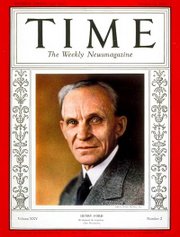
Henry Ford (July 30, 1863 – April 7, 1947) was the founder of the Ford
Motor Company and is credited with contributing to the creation of a middle class
in American society. He was one of the first to apply assembly line manufacturing
to the mass production of affordable automobiles. This achievement not only revolutionized
industrial production in the United States and the rest of the world, but also
had such tremendous influence over modern culture that many social theorists
identify this phase of economic and social history as "Fordism."
Background
Ford was born on a prosperous farm in Springwells Township (now in
the city of Dearborn, Michigan) owned by his parents, William and
Mary Ford, immigrants from County Cork, Ireland. He was the eldest
of six children. As a child, Henry was passionate about mechanics,
preferring to tinker in his father's shop over doing farm chores.
At 13, he saw a self-propelled vehicle, a steam powered thresher,
for the first time.
In 1879, he left home for the nearby city of Detroit to work as an apprentice machinist, first with James F. Flower & Bros., and later with the Detroit Dry Dock Co. In 1882, he returned to Dearborn to work on the family farm and became adept at operating the Westinghouse portable steam engine. This led to his being hired by Westinghouse company to service their steam engines. Upon his marriage to Clara Bryant in 1888 Ford supported himself by farming and running a sawmill.
In 1891, Ford became an engineer with the Edison Illuminating Company, and after his promotion to Chief Engineer in 1893, he had enough time and money to devote attention to his personal experiments on internal combustion engines. These experiments culminated in 1896 with the completion of his own self-propelled vehicle named the Quadricycle, which he test-drove on June 4 of that year.
After this initial success, Ford left Edison Illuminating and, with other investors, formed the Detroit Automobile Company. The Detroit Automobile Company went bankrupt soon afterward because Ford continued to improve the design, instead of selling cars. Ford raced his vehicles against those of other manufacturers to show the superiority of his designs. With his interest in race cars, he formed a second company, the Henry Ford Company. During this period, he personally drove his Quadricycle to victory in a race against Alexander Winton, a well-known driver and the heavy favorite on October 10, 1901. Ford was forced out of the company by the investors, including Henry M. Leland in 1902, and the company was reorganized as Cadillac.
Ford Motor Company
Henry Ford, with eleven other investors and $28,000 in capital, incorporated
the Ford Motor Company in 1903. In a newly-designed car, Ford drove
an exhibition in which the car covered the distance of a mile on the
ice of Lake St. Clair in 39.4 seconds, which was a new land speed record.
Convinced by this success, the famous race driver Barney Oldfield,
who named this new Ford model "999" in honor of a racing
locomotive of the day, took the car around the country and thereby
made the Ford brand known throughout the U.S. Henry Ford was also one
of the early backers of the Indianapolis 500.
The Model T
In 1908, the Ford company released the Model T. From 1909 to 1913,
Ford entered stripped-down Model Ts in races, finishing first (although
later disqualified) in an "ocean-to-ocean" (across the USA)
race in 1909, and setting a one-mile oval speed record at Detroit Fairgrounds
in 1911 with driver Frank Kulick. In 1913, Ford attempted to enter
a reworked Model T in the Indianapolis 500, but was told rules required
the addition of another 1,000 pounds (450 kg) to the car before it
could qualify. Ford dropped out of the race, and soon thereafter dropped
out of racing permanently, citing dissatisfaction with the sport's
rules and the demands on his time by the now-booming production of
the Model Ts.
Racing was, by 1913, no longer necessary from a publicity standpoint because the Model T was already famous and ubiquitous on American roads. It was in this year that Henry Ford introduced the moving assembly belts into his plants, which enabled an enormous increase in production. Although Ford is often credited with the idea, contemporary sources indicate that the concept and its development came from employees Clarence Avery, P.E. "Ed" Martin, Charles E. Sorensen, and C.H. Wills.
By 1918, half of all cars in America were Model Ts. The design, fervently promoted and defended by Henry Ford, would continue through 1927 (well after its popularity had faded), with a final total production of fifteen million vehicles. This was a record which would stand for the next 45 years. Ford said, "Any customer can have a car painted any colour that he wants so long as it is black." (See References at bottom)
On January 1, 1919, after unsuccessfully seeking a seat in the United States Senate, Henry Ford turned the presidency of Ford Motor Company over to his son Edsel, although still maintaining a firm hand in its management—few company decisions under Edsel's presidency were made without approval by Henry, and those few that were, Henry often reversed. Also at this time, Henry and Edsel purchased all remaining stock from other investors, thus becoming sole owners of the company. The company remained privately held by the family until 1956, when the family allowed a public offering of a portion of the company without ceding control.
By the mid 1920's, sales of the Model T began to decline due to rising competition. Other auto makers offered payment plans through which consumers could buy their cars, which usually included more modern mechanical features and styling not available with the Model T. Despite urgings from Edsel, Henry steadfastly refused to incorporate new features into the Model T or to form a customer credit plan.
The Model T's key to success was the fact that it had been made in the assembly line, which allowed for many different cars to be made consecutively, identically and much faster than other hand made vehicles. The cars sales triggered the modern era of vehicles. For the first time everyone could own a car, the downside was that every Model T produced after 1913, (the year the assembly line was created) was painted black because the paint dried a lot faster than any other color. The Model T was a very simple car, as simple as it could be made. One screw held 10 or 20 parts. But that's what made it unique. Henry Ford's assembly line was so unique that it turned the Ford Motor Company into a Giant, (and became a tool for every other industry that creates merchandise in the assembly line, of course the assembly line does not use people anymore, but uses robots) while the other car companies were still stuck with the technologies of the earlier days. By 1928 there were about 30 million cars world wide. Half of these were Ford Model Ts.
The Model A and later
By 1926, flagging sales of the Model T convinced Henry of what Edsel
had been suggesting for some time: a new model was necessary. The elder
Ford pursued the project with a great deal of technical expertise in
design of the engine, chassis, and other mechanical necessities, while
leaving it to his son to develop the body design. Edsel also managed
to prevail over his father's initial objections in the inclusion of
a sliding-shift transmission. The result was the highly successful
Ford Model A, introduced December, 1927 and produced through 1931,
with a total output of over four million automobiles. Subsequently,
the company adopted an annual model change system similar to that in
use by automakers today.
During the thirties, Ford also overcame his objection to finance companies, and the Ford-owned Universal Credit Company became a major car financing operation.
Henry Ford long had an interest in plastics developed from agricultural products, especially soybeans. Soybean-based plastics were used in Ford automobiles throughout the 1930s in plastic parts such as car horns, in paint, etc. This project culminated in 1942, when on January 13 Ford patented an automobile made almost entirely of plastic, attached to a tubular welded frame. It weighed 30% less than a standard car of the same size, and was said to be able to withstand blows ten times greater than could steel. Furthermore, it ran on grain alcohol (ethanol) instead of gasoline. The design never caught on.
On May 26, 1943, Edsel Ford died, leaving a vacancy in the company presidency. Henry Ford advocated Harry Bennett to take the spot. Edsel's widow Eleanor, who had inherited Edsel's voting stock, wanted her son Henry Ford II to take over the position. The issue was settled for a period when Henry himself, at the age of 79, took over the presidency personally. Henry Ford II was released from the navy and became an executive vice president, while Harry Bennett had a seat on the board and was responsible for personnel, labor relations, and public relations.
The company saw hard times during the next two years, losing $10 million a month. President Franklin D. Roosevelt considered a federal bailout for Ford Motor Company so that wartime production could continue. By 1945 Henry Ford's senility was quite evident, and his wife and daughter-in-law forced his resignation in favor of his grandson, Henry Ford II.
Ford's labor philosophy
Henry Ford had very specific thoughts on relations with his employees.
On January 5, 1914 Ford announced his five-dollar a day program. The
program called for a reduction in length of the workday from 9 to 8
hours and a raise in minimum daily pay from $2.34 to $5 for qualifying
workers. Ford labeled the increased compensation as profit sharing
rather than wages. The wage was offered to men over the age of 22,
who had worked at the company for 6 months or more, and, importantly,
conducted their lives in a manner of which Ford approved. The company
established a Sociological Department complete with 150 investigators
and support staff in order to verify this last point. Even with these
requirements a large percentage of workers were able to qualify for
the profit sharing.
In 1926, Ford instituted the five-day, forty-hour work-week, effectively inventing the modern weekend. In granting workers an extra day off, Ford ensured leisure time for the working class. The "short week," as Ford called it in a contemporary interview, was required so that the country could "absorb its production and stay prosperous."
Conversely, Ford was adamantly against labor unions in his plants. To forestall union activity, he promoted Harry Bennett, a former Navy boxer, to be the head of the Service Department. Bennett employed various intimidation tactics to squash union organizing. The most famous incident, in 1937, was a bloody brawl between company security men and organizers that became known as The Battle of the Overpass.
Ford was the last Detroit automaker to recognize the United Auto Workers union (UAW). A sit-down strike by the UAW union on April 2, 1941 closed the River Rouge Plant. Under pressure from Edsel and his wife, Clara, Henry Ford finally agreed to collective bargaining at Ford plants, and the first contract with the UAW was signed in June 1941.
Anti-Semitism and The Dearborn Independent
Henry Ford began publication of a newspaper, The Dearborn Independent,
in 1919. The paper ran for eight years, during which it republished "Protocols
of the Learned Elders of Zion," which has since been discredited
by virtually all historians as a forgery. The American Jewish Historical
Society describes the ideas presented in it as "anti-immigrant,
anti-labor, anti-liquor, and anti-Semitic".
The Independent also published, in Ford's name, several anti-Jewish articles which were released in the early 1920s as a set of four bound volumes, cumulatively titled "The International Jew, the World's Foremost Problem." These volumes were distributed through Ford's car dealerships. Denounced by the Anti-Defamation League (ADL), the articles nevertheless explicitly condemned pogroms and violence against Jews (Volume 4, Chapter 80), preferring to blame incidents of mass violence on the Jews themselves. None of this work was actually penned by Ford, though they required his tacit approval since he was the paper's publisher.
Lawsuits in response to anti-Semitic remarks led Ford to close the Dearborn Independent in December 1927. He later retracted the International Jew and the Protocols. On January 7, 1942, Henry Ford wrote a public letter to the ADL denouncing hatred against the Jews and expressing his hope that anti-Jewish hatred would cease for all time. Some claim that Ford neither wrote nor signed this letter and have questioned the sincerity of his apology. His writings continue to be used as propaganda by various groups, often appearing on anti-Semitic and neo-Nazi websites.
Henry Ford and Nazism
Ford became interested in politics and as a successful and powerful
business leader, was sometimes a participant in world affairs. In 1915,
he funded a trip to Europe, where World War I was raging, for himself
and about 170 others. His group went to meet with German and other
European leaders -- without U.S. government support or approval --
to seek peace. The war lasted another three years.
In the years between the wars, Henry Ford spent years bestowing gushing praise on Adolf Hitler's Nazi regime, although this praise abated as the United States entered WWII. There is also some evidence that Henry Ford gave Adolf Hitler direct financial backing when Hitler was first starting out in politics. This can in part be traced to statements from Kurt Ludecke, Germany's representative to the U.S. in the 1920s, and Winifred Wagner, daughter-in-law of Richard Wagner, who said they requested funds from Ford to aid the National Socialist movement in Germany. However, a 1933 Congressional investigation into the matter was unable to substantiate whether contributions were actually sent. Regardless of whether direct financial support was provided, Ford repeatedly voiced his overt approval of Hitler's theories.
Ford's indirect financial backing of the Nazis was also undeniable, as Ford Motor Company was active in Germany's military buildup prior to World War II. In 1938, for instance, it opened an assembly plant in Berlin, the purpose of which was to supply trucks to the Wehrmacht. In July of that year, Ford was awarded (and accepted) the Grand Cross of the Order of the German Eagle (Großkreuz des Deutschen Adlerordens). Ford was the first American and the fourth person given this award, at the time Nazi Germany's highest honorary award given to foreigners. The decoration was given "in recognition of [Ford's] pioneering in making motor cars available for the masses." The award was accompanied by a personal congratulatory message from Adolf Hitler. [Detroit News, July 31, 1938.]
Hobbies and interests
Ford had an interest in what today would be known as "Americana".
In the 1920s, Ford began work to turn Sudbury, Massachusetts into an
Americana-themed historical village. He moved the schoolhouse from
the Mary had a little lamb nursery rhyme from Sterling, Massachusetts
and purchased the historical Wayside Inn. This plan never saw fruition,
but Ford repeated it with the creation of Greenfield Village in Dearborn,
Michigan. It may have inspired the creation of Old Sturbridge Village
as well. About the same time, he began collecting materials for his
museum, which had a theme of practical technology. It was opened in
1929 as the Edison Institute and, although greatly modernized, remains
open today.
Ford also had an interest in American folk music, which he shared with his friend Dr. Lloyd Shaw, and frequently sponsored square dances, one of his particular interests.
Ford was an early promoter of aviation, building the Dearborn Inn as the first airport hotel. (The airfield was across the street and is now the site of a Ford Motor Company test track.) He heavily sponsored the Stout Metal Airplane Company, which developed the Ford Tri-Motor, an early airliner.
Ford also maintained a vacation residence (known as the "Ford Plantation") in Richmond Hill, Georgia. He contributed substantially to the community, building a chapel and schoolhouse and employing a large number of local residents. His knowledge of the Ontario town of the same name is believed to have led to the renaming of the Georgia town, formerly known as Ways Station.
The Ford Foundation
Henry Ford, with his son Edsel, founded the Ford Foundation in 1936
as a local philanthropic organization with a broad charter to promote
human welfare. The Foundation has grown immensely and, by 1950, had
become national and international in scope.
The foundation no longer has any association with the Ford Motor Company, nor with the family or descendants of Henry Ford.
The final days
Ford suffered an initial stroke in 1938, after which he turned over
the running of his company to Edsel. Edsel's 1943 death brought Henry
Ford out of retirement. In ill health, he ceded the presidency to his
grandson Henry Ford II on September 21, 1945, and went into retirement.
He died in 1947 of a cerebral hemorrhage at the age of 83 in Fair Lane,
his Dearborn estate, and is buried in the Ford Cemetery in Detroit.
This biography is courtesy of Wikipedia, the free encyclopedia