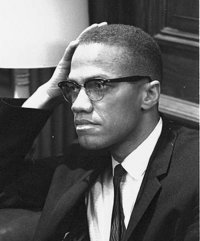
Malcolm X (May 19, 1925 – February 21, 1965 – also: Malcolm Little,
Detroit Red, El-Hajj Malik El-Shabazz, and Omowale) was a spokesman for the Nation
of Islam. Malcolm X was the founder of both the Muslim Mosque, Inc. and the Organization
of Afro-American Unity.
Biography
During his life, Malcolm went from being a street-wise Boston hoodlum
to one of the most prominent black nationalist leaders born in the
United States. As a militant leader, Malcolm X advocated black pride,
economic self-reliance, and identity politics. He ultimately rose
to become a world renowned Pan-Africanist and human rights activist.
According to FBI reports, Malcolm X was 6 feet, 3.5 inches (192 cm)
tall. Malcolm X was assassinated in New York City on February 21,
1965 on the first day of National Brotherhood Week.
He explained the name he chose by saying,
"To take one's 'X' is to take on a certain mystery, a certain
possibility of power in the eyes of one's peers and one's enemies ...
The 'X'; announced what you had been and what you had become: Ex-smoker,
Ex-drinker, Ex-Christian, Ex-slave."
The 'X' also stood for the unknown original surname of the slaves from
whom Malcolm X descended, in preference to continuing to use a name
which would have been given by the slave owner. This rationale made
many members of the Nation of Islam choose their own surnames.
Early years
Malcolm X was born Malcolm Little in Omaha, Nebraska to Earl Little
and Louise Little (née Norton). His father, an outspoken Baptist
lay preacher and supporter of Marcus Garvey, was believed to have been
killed by the Black Legion, a white supremacist group in Lansing, Michigan
in 1931. Malcolm and his siblings had been split up and sent to different
foster homes when Louise Little was declared legally insane. In 1939,
she was formally committed to the State Mental Hospital at Kalamazoo,
Michigan, and remained there until Malcolm and his brothers and sisters
got her released twenty-six years later.
Malcolm graduated from junior high school at the top of his class, but dropped out when his favorite teacher crushed his dream to be a lawyer by saying that it was "no realistic goal for a nigger"[1]. After enduring a series of foster homes, Malcolm was first sent to a detention center and then later moved to Boston to live with his older half-sister, Ella Little Collins. He found work as a shoeshiner at a Lindy Hop nightclub; in his autobiography, he says that he once shined the shoes of Duke Ellington and other notable black musicians. After some time, he moved to New York City, where, in Harlem, he became involved in drug dealing, gambling, pimping, racketeering, and robbery (referred to collectively by Malcolm as "hustling"). When he was examined for the World War II draft, military physicians found him to be insane[2], barring him from military service; he claimed to have feigned insanity to avoid being drafted.
Prison
Malcolm became a small time hustler and was known on the street as
'Detroit Red' (due to his hair color, which was naturally red, actually,
he conked it, which made it red. He was arrested in Boston on January
12, 1946 at the age of 20 and sentenced to eight to ten years imprisonment
on charges of breaking and entering, carrying firearms, and larceny.
He later earned the nickname Satan in the Charlestown State Prison
for his constant cursing, especially of God and the Bible. While in
jail in 1948, he received letters from his brother Reginald, asking
him to join the Nation of Islam. The NOI defined itself as a militant
Islamic sect that preached that most African slaves were Muslims before
they were captured and sent to the Americas. They argued that Blacks
should reconvert to Islam to reclaim the heritage that was stolen from
them. The NOI considered itself to be a black nationalist group which
supported the idea of a separate Black nation within the United States.
The NOI also considers non-Blacks as subhuman, in particular Jews and
Anglo-Saxons whose existence is owed to an experiment by a black scientist
named Yakub gone wrong.
Malcolm diligently studied the teachings of founder and leader of the Nation of Islam Elijah Muhammad. His sister Ella helped to transfer him to the lower-security prison colony in Norfolk, Massachusetts where he became an avid reader and found justification for the teachings of Elijah Muhammad and the Nation of Islam in history and philosophy. He participated in the colony's weekly debates, and copied an entire dictionary from the colony's library to expand his knowledge and to improve his handwriting. His first contact with Elijah Muhammad was in prison, where he corresponded with Muhammad by mail. As he progressed in his self-education, he began to write to the leader daily. After his release on parole on August 7, 1952, he bought a suitcase, eyeglasses, and a watch, later saying that these were the items he used most in his later life.
Nation of Islam
In 1952, after his release from prison, Malcolm went to meet Elijah
Muhammad in Chicago. It is here that he received the iconic X, meant
to symbolize the rejection of his slave-name and the absence of a proper
African Muslim name. The "X" is also both a reference to
the name given to the slaves by the Anglo-European slave owners, unwilling
and un-wanting to learn their African names; and is also the brand
that many slaves received on their upper arm.
In March of 1953 the FBI opened a file on Malcolm, supposedly in response to an allegation that he had described himself as a Communist; according to the Church Committee, the FBI had long been used to monitor, disrupt, and repress radicals like Malcolm. Included in the file were two letters wherein Malcolm uses the alias "Malachi Shabazz". In "Message To The Black Man In America", Elijah Muhammad explained the name Shabazz as belonging to descendants of an "Asian Black nation".
In May of 1953 the FBI concluded that Malcolm X had an "asocial personality with paranoid trends (pre-psychotic paranoid schizophrenia)", and had in fact, sought treatment for his disorder. This was further supported by a letter intercepted by the FBI June 29, 1950. In the letter said, in reference to his 4-F classification and rejection by the military "Everyone has always said Malcom is crazy, so it isn't hard to convince people that I am.".
Later that year, Malcolm left his half-sister Ella in Boston to stay with Elijah Muhammad in Chicago. He soon returned to Boston and became the Minister of the Nation of Islam's Temple Number Eleven.
His active membership in the Nation of Islam led to him opening several temples around the country, of which he often became Minister. His rousing, incendiary and inspirational speeches and spotless personal example led to the ranks of the Nation of Islam burgeoning. He was soon seen as the number two man in the movement, next to Elijah Muhammad himself. He was largely credited with increasing membership in the NOI from 500 in 1952 to 30,000 in 1963. In 1958 Malcolm married Betty X (née Sanders) in Lansing, Michigan. They had six daughters together, all of whom carried the surname of Shabazz: Attillah, born in 1958; Qubilah born in 1960; Ilyasah born in 1962; Gumilah born in 1964 and twins, Malaak and Malikah, who were born after Malcolm's death in 1965.
As Malcolm worked tirelessly for the Nation of Islam, he was increasingly exposed to rumours of Elijah Muhammad's extra-marital affairs with young secretaries. Adultery is severely shunned in the teachings of the Nation of Islam. Although this news unsettled Malcolm, he often brushed it aside. But soon he investigated these allegations and saw that they were true, and they were eventually affirmed by Elijah Muhammad himself, who claimed that it was legitimate for him to take on wives as he was the messenger of God. (It should be noted that polygamy, as marriage to more than one but less than five women, and when specifically recognised and accepted under Sharia, is not a transgression in the mainstream Islamic religion. Elijah Muhammad, however, was not married to any of the women with whom he had affairs but ended in having children with each woman.) In fact, Elijah Muhammad asked Malcolm to cover his affairs but Malcolm refused. Despite being unsatisfied with the excuses, and being disenchanted by other ministers using Nation of Islam funds to line their own pockets, Malcolm's faith in Elijah Muhammad did not waver.
By the summer of 1963, tension in the Nation of Islam reached boiling point. Malcolm believed that Elijah Muhammad was jealous of his popularity (as were several senior ministers). Malcolm watched the March on Washington critically, unable to understand why black people were excited over a demonstration "run by whites in front of a statue of a president who has been dead for a hundred years and who didn't like us when he was alive." Later in the year, following the assassination of President John F. Kennedy, Malcolm delivered a speech as he regularly would. However, when asked to comment upon the assassination, he replied that it was a case of "chickens coming home to roost" – that the violence that JFK had failed to stop, and at times refused to rein in had come around to claim his life. Most explosively, he then added that with his country origins, "Chickens coming home to roost never made me sad. It only made me glad." This comment led to widespread public outcry and led to the Nation of Islam's publicly censuring Malcolm X. Although retaining his post and rank as minister, he was banned from public speaking for ninety days by Elijah Muhammad himself. Malcolm obeyed and kept quiet.
In the spring of 1963, Malcolm started collaborating on The Autobiography of Malcolm X with Alex Haley. He also publicly announced his break from the Nation of Islam on March 8, 1964 and the founding of the Muslim Mosque, Inc. on March 12, 1964. At this point, Malcolm mostly adhered to the teachings of the Nation of Islam, but began modifying them, explicitly advocating political and economic black nationalism as opposed to the NOI's exclusivist religious nationalism. In March and April, he made the series of famous speeches called "The Ballot or the Bullet" [4]. Malcolm was in contact with several orthodox Muslims, who encouraged him to learn about orthodox Islam. He soon converted to orthodox Islam, and as a result decided to make his Hajj.
Hajj
On April 13, 1964, Malcolm departed JFK Airport, New York for Cairo,
Egypt by way of Frankfurt, Germany. It was the second time Malcolm
had been to Africa. Malcolm left Cairo arriving in Jeddah, Saudi Arabia
about three in the morning. He was automatically suspect due to his
inability to speak Arabic and his U. S. passport. He was separated
from the group he came with and was isolated. He spent about 20 hours
wearing the ihram, a two-piece towel outfit wrapping the wearer from
the waist down with one towel and from the waist upward with the other.
It was at this time he remembered the book The Eternal Message of Muhammad by Abdul Rahman Hassan Azzam and which Dr. Mahmoud Yousseff Sharwabi had presented to him with his visa approval. He called Azzam's son who arranged for his release. At the younger Azzam's home he met Azzam Pasha who gave Malcolm his suite at the Jedda Palace Hotel. The next morning Muhammad Faisal, the son of Prince Faisal, visited and informed him that he was to be a state guest. The deputy chief of protocol accompanied Malcolm to the Hajj Court. It therefore was a mere formality for Sheikh Muhammad Harkon to allow Malcolm to make his Hajj (pilgrimage to Mecca). On April 19 he completed the Umrah, making the seven circuits around the Kaaba, drinking from the well of Zamzam and running between the hills of Safah and Marwah seven times. The trip proved to be life-altering. He had come to see Islam as the one religion that could erase all racial problems.
On May 21, 1964, he returned to the United States as an traditional Sunni Muslim (and with a new name – El-Hajj Malik El-Shabazz). Along with A. Peter Bailey and others, he then founded the U. S. branch of the Organization of Afro-American Unity. Patterned after the Organization of African Unity (OAU), Africa's continental organization, which was established at Addis Ababa, Ethiopia, in May 1963, the OAAU resolved to establish a non-religious and non-sectarian program for human rights. The OAAU included all people of African ancestry in the western hemisphere, as well as those on the African continent. When he returned to the U. S., he gave a speech about his visit. This time he gave a much larger meaning and message than before. The speech was not only for the Muslims, instead it was for the whole nation and for all races. He said, "Human rights are something you were born with. Human rights are your God-given rights. Human rights are the rights that are recognized by all nations of this earth."
Africa
Among the little known and least mentioned facts about the life of
Malcolm X are his excursions in Africa. In all, Malcolm X visited Africa
on three separate occasions, once in 1959 and twice in 1964. During
his visits, he met officials, as well as spoke on television and radio
in such diverse places as: Cairo, Egypt; Addis Ababa, Ethiopia; Dar
Es Salaam, Tanganyika (now Tanzania); Lagos and Ibadan, Nigeria; Accra,
Winneba, and Legon, Ghana; Conakry, Guinea; Algiers, Algeria; and Casablanca,
Morocco.
Malcolm first went to Africa in summer of 1959. He traveled to Egypt (United Arab Republic), Sudan and Nigeria and Ghana to arrange a tour for Elijah Muhammad, which occurred in December 1959. The first of Malcolm's two trips to Africa in 1964 lasted from April 13 until May 21. On May 8, following his speech at Trenchard Hall on the campus of the University of Ibadan in Nigeria, he attended a reception in the Students' Union Hall held for him by the Muslim Students' Society. It was during this reception that the students bestowed upon him the name "Omowale" (Oh-Moh-wah-lay), meaning "the son returns home" in the Yoruba language.
Malcolm returned to New York from Africa via Paris, France, on May 21, 1964. On July 9, he again left the U. S. for Africa, spending a total of 18 weeks abroad. On July 17, 1964, Malcolm addressed the Organization of African Unity's first ordinary assembly of heads of state and governments in Cairo as a representative of the OAAU. On August 21, 1964, he made a press statement on behalf of the OAAU regarding the second African summit conference of the OAU. In it, he explains how a strong and independent "United States of Africa" is a victory for the awakening of African Americans. By the time he returned to the U. S. on November 24, 1964, Malcolm had established an international connection of brotherhood between Africans on the continent and those in the diaspora.
Death and afterwards
In 1964, Life magazine published a famous photograph of Malcolm X holding
an M1 Carbine and pulling back the curtains to peer out of a window.
This photograph is a popular image on T-shirts and often appears with
the slogan "By any means necessary." The photo was taken
in connection with Malcolm's declaration that he would defend himself
from the daily death threats which he and his family were receiving.
The undercover FBI informants warned officials that Malcolm X had been
marked for assassination. One officer undercover with the Nation of
Islam reportedly had been ordered to help plant a bomb in Malcolm's
car.
Tensions increased between Malcolm and the Nation of Islam. It was alleged that orders were given by members of the Nation of Islam leadership to kill Malcolm. On February 14, 1965, his home in New York City was firebombed. Malcolm and his family survived. Some say it was done by members of the Nation of Islam. No one has been charged in that crime. A week later on February 21, in Manhattan's Audubon Ballroom, Malcolm had just begun delivering a speech when a disturbance broke out in the crowd of 400. A man yelled, "Get your hand outta my pocket! Don't be messin' with my pockets!" As Malcolm's bodyguards rushed forward to attend to the disturbance, a black man rushed forward and shot Malcolm in the chest with a sawed-off shotgun. Two other men quickly charged towards the stage and fired handguns at Malcolm. Angry on-lookers in the crowd caught and beat the assassins as they attempted to flee the Ballroom. Malcolm X had died at the age of 39.
Fifteen hundred people attended Malcolm's funeral in Harlem on February 27, 1965 at the Faith Temple Church of God in Christ (now Child's Memorial Temple Church of God in Christ). After the ceremony, friends took the shovels away from the waiting gravediggers and buried Malcolm themselves. Malcolm X was buried at the Ferncliff Cemetery in Hartsdale, New York. Three people were arrested for his murder: Nation of Islam members Talmadge Hayer, Norman 3X Butler, and Thomas 15X Johnson. All three were convicted of first-degree murder in March 1966. Hayer himself appears to be the only man guilty of the assassination; he later gave the names of the other assassins as Albert Thomas, Leon David, William Bradley, and Wilbur McKinley. Some independent investigators familiar with details of the case have accused current Nation of Islam leader Louis Farrakhan of having played a major role in the planning of the assassination while others claim Elijah Muhammad himself, fearing Malcolm's rising influence, ordered him killed. Farrakhan gave an interview to the CBS news program 60 Minutes in 1998 in which he denied the allegations.
Despite his change of methods late in life, Malcolm X was most remembered for his remarkable oratorial delivery of his fiery anti-racist speeches, which were emulated by other black militant organizations and leaders such as the Black Panthers and Stokely Carmichael.
This biography is courtesy of Wikipedia, the free encyclopedia